Showing posts with label education. Show all posts

Saturday, July 27, 2019

Rise and Shine! Back to School Visual Aid Printables


First day of school! First day of school! Our kids just finished their first (partial) week at their new school and while it's a whole new world of backpacks, lockers, and homework assignments G-bug and Truth are thoroughly enjoying it.

G-bug the 7th grader!

I've also been so blessed with the opportunity to work on campus as a student support aide in the elementary educational resource department, providing assistance for students who need extra support during the school day. It's so wonderful to work in such an amazing school and with such incredible teachers and staff - I'm excited to learn from them this year, and hopefully be a part of creating a positive and exciting learning environment for the students. :)


With this huge shift in our schooling routine, the biggest challenge that we've faced has been getting up early and out the door on time. It has been a new experience for all of us: packing lunches and backpacks, morning car lines, remembering musical instruments, turning in signatures and forms to teachers, and on and on. Thankfully, we were given some counsel from G-bug's neuropsychologist before the school year began to provide laminated visual aids/checklists to use every school night/morning to stay organized. He explained that it would help to minimize anxiety, and would also encourage independence and development of organization skills. It also prevents Mom having to carrying the burden of remembering all the things (especially since Mom's working memory is still recovering after surgery and the years of yuck - I'll post an update on my health soon in a separate post, more good news!)


After three days of school, I can confidently say that these visual aids have been a lifesaver. LIFE. SAVER. Both kids have responded so positively to this system: G-bug is able to practice her executive skills and develop her independence without constant reminders and redirections, and Truth (my super organized but slightly anxious child) finds comfort in knowing exactly what is expected of him.

Lunchbox? Check.
Flute in backpack? Checkity-check.

Every night when it's time for bedtime routine, the kids will start their school night checklists - using a dry erase marker, they check off each box when the task is completed. When they're finished, they have to turn in their checklists to a parent for review (the same goes for the morning checklists). If they miss a step, they are instructed to go back and finish the task. We practiced this routine 1-2 nights/days preceding the start of school to get the hang of it, so that by the first day of school we had worked through any potential issues and could tackle the list with confidence.

In case it is helpful for any parents/students who are preparing for another school year, here are links to customizable versions of these printable checklists  for your family to try - each list is an extra blank checkbox that you can write in any additional tasks particular to your family/child before laminating. (For example, our morning checklists include putting on glasses.) There are two versions to choose from: one that includes medication/vitamins and one that doesn't. 

If there are families who would like a homeschool version, please contact me via email and I'll be happy to create one for you as well!

 School Night/Morning Checklists Printable

 School Night/Morning Checklists NO Meds Printable


Please let me know if you find these helpful! And have a wonderful school year. :)
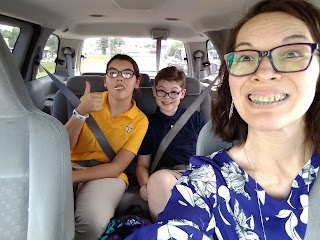

We give school a big thumbs up!

Thursday, May 30, 2019

Last Day of School at Four Maples Academy


Last day of school! It is also our last day of homeschooling at Four Maples Academy. So many emotions today, but mostly thankfulness.

We have absolutely loved the last seven years of educating Gracie and Emmett at home. It gave us the freedom to tailor lessons to each student's needs/speed, and to incorporate therapies and supports to help build a strong educational foundation for each of them. It has been a gift to shepherd the kids through areas of struggle and to celebrate the big and small academic and developmental victories with them. Our morning bible studies have been rich with meaningful conversations and honest questions, which is probably what I will miss the most.

One of my favorite Bible study discussions


It was incredibly humbling and encouraging to recently discover how much Gracie and Emmett have flourished and grown at Four Maples: both kids tested above average in reading comprehension, writing, and math (and Emmett officially skipped a grade somewhere between 1st and 3rd grade). There were definitely tears of joy and relief upon hearing this news. And gratitude. So much gratitude.

The kids will begin a new chapter in the fall... at Christian Academy of Indiana! We're so excited to see how the Lord will lead them to new opportunities in learning, personal growth, and making new friendships. Seventh and fifth grade, here we come!

Sunday, August 19, 2018

Nature Walk Ideas


Nature walks are one of the easiest and cost-effective activities you can do with you kids. Children of all ages can find something interesting to do/see while exploring the great outdoors. (Equally true for grown ups like me who don't particularly love hiking. Or sweating. Or mosquitoes.)

Charlotte Mason (a British English educator in the 1800s whose writings created the foundation for the homeschooling philosophy that carries her name) believed that regular exploration and investigation outdoors among nature encouraged a vital foundation of curiosity and investigation in children:
"It is infinitely well worth the mother’s while to take some pains every day to secure, in the first place, that her children spend hours daily amongst rural and natural objects; and, in the second place, to infuse into them, or rather, to cherish in them, the love of investigation...

"The child who learns his science from a text-book, though he go to Nature for illustrations, and he who gets his information from object lessons, has no chance of forming relations with things as they are, because his kindly obtrusive teacher makes him believe that to know about things is the same as knowing them personally...

"Let them once get in touch with nature and a habit is formed which will be a source of delight and habit through life..."

Here are a few ideas/activities to inspire you as you plan to explore God's creation as a family and encourage your children's curiosity and discovery:
  • Make up a nature walk scavenger hunt: before heading out, write up a list of different items to look for and check items off the list as you find them.  Some examples: different kinds of acorns/seeds, colored leaves, insects, plants, rocks, birds, or animals. You can even bring a camera and make it a photo scavenger hunt!
  • Buy some cheap binoculars and let the kids use them to spot far away objects like birds in trees, or turtles swimming lazily in a lake. (We lucked out and got some in fast food kids meals!)

The beauty of nature is everywhere!

  • Have the kids keep a nature journal: record observations by writing/drawing pictures of things they saw in a special notebook specifically for that purpose.  Have them draw/label items, collect and tape/glue leaves and seeds they find, do leaf rubbings. We actually started keeping a box in our school closet with our most interesting nature findings: cicada shells, a broken eggshell, etc. (Be sure kids wash their hands after handling!)


  • One mom had a brilliant idea for toddlers/preschoolers: collect different colored items (flowers, leaves, etc) while on a neighborhood walk, and then create a display on paper by sorting the items by color:
    Thanks Bethany for permission to share your idea/photo!

    • If you have a park or nature center within driving distance, USE IT.  Many of them have easy trails to hike and often host kid-friendly events or activities throughout the year.
     Butterfly display at the Louisville Nature Center

    Hello, Nature? Is that you?

    Lastly, be sure to allow lots of margin to let your children to investigate, explore, and study the things in nature that interest them. (Warning: This might require you to hide your cringes while they poke at a particlarly disgusting bug or take the time to study a pile of termites eating their way through a fallen log.) G-bug and Truth have often surprised me with their thoughtful questions and observations while on our walks, and have regularly educated me in how a particular animal, bird, or plant behaves. Amazing.

    Comment below and share your favorite places and memories that you've enjoyed while exploring the great outdoors!

    Monday, October 5, 2015

    The Blessing of Frequent Breaks (Finding Your Rhythm)

    It's Monday morning, 10:36am. We have (almost) hit our mid-point of the school day, and the kids are cheerfully swinging outside and lip syncing to the Frozen movie soundtrack. Life is pretty good.

    Let it go! Let it gooooo!

    One of my favorite things about homeschooling is the freedom to find your own rhythm and customizing your schedule to fit the needs of your own particular children, and your own needs as well!

    Each year at Four Maples has looked a little different. G-bug is in 3rd grade now, and Emmett is in 1st-ish grade (he's somewhere between 1st and 3rd grade, another benefit to homeschool!). Our work loads have increased, and the content overall has become more complex and challenging. We have even added our sweet friend H for preschool twice a week! How do we fit it all in, and meet everyone's educational needs?

    Ninja teacher skills.

    Just kidding.

    Actually, here are three guidelines that have helped Four Maples stay on track (and helped me stay sane!).


    #1: A Set Schedule

    It usually takes a few weeks, but after some trial and error we usually settle into a routine that overall works great for both myself and the kids. I have been asked by a couple of friends how we conduct our school days, so here is a breakdown of our current daily schedule:

    9:00 - 9:25am  - Morning prayer/Bible study (this year: the Book of Matthew)

    9:25 - 9:30am  - Break

    9:30 - 9:55am  - Handwriting/English (with separate study stations/one-on-one instruction)

    9:55 - 10:00am -  Break

    10:00 - 10:30am - Geography

    10:30 - 11:00am - Snack Break/Free Play (usually outside)

    11:00 - 12:00pm - Spelling (one-on-one tutoring style)

    12:00 - 12:30pm - Lunch Break/Free Play

    12:00 - 1:00pm - Math

    1:00 - 1:05pm - Break

    1:05 - 1:30pm - Science

    1:30 - 1:35pm - Break

    1:30 - 2:00pm - Art/Music (not every day - they go to a weekly art class)

    Some days look a little different, but this rhythm of learning works best for us. Lots of little breaks with two longer breaks throughout the day has been a HUGE contributor in our kids' willingness and cheerfulness to work hard and enjoy the learning process, and still have time to just play and be kids.


    #2: Frequent Breaks

    For anyone who has spent time with children, you realize that sitting still isn't one of their fortes. There are developmental reasons for this, as well as individual temperament, personality, physical makeup, and sometimes special needs/considerations. This isn't a bad thing! In fact, children (especially ages 7 and under) need lots of time to move, explore, and play to encourage their natural development and learning, as highlighted in this article.

    In short: kids need to be able to move and play. Often.

    Breaking up more intensive learning with scheduled times to get up, move, dance, swing, run, or sometimes lay down in bed with a weighted blanket can help reward hard work and motivate through more challenging lessons. We sandwich our hardest subjects between the longer breaks during the day because it will take the most effort to complete and will need time to recover before moving on to the next subject.

    Sometimes a kid just needs to ride a bike


    Frequent breaks also:

    - gives children time to process the information they have learned before jumping into the next subject

    - give time to chat together and practice social skills

    - allow time for free play and exercise their imaginations (sometimes the history or science lesson beforehand finds its way into the imaginative play, bonus!)

    - make it easier to incorporate younger children into lessons (older kids benefit from frequent breaks, but younger kids require them)

    - provide opportunities to do therapy games when needed in between subjects to help with focus, attention, sensory needs, etc. For example, G-bug almost always swings during mid-morning snack break, or on cold/rainy days dances/spins downstairs to music. Forward/backward swinging and spinning is calming/regulating for her, which helps to prepare her for the hardest subject of her day (spelling/dictation).

    - give the teacher (ahem, ME) time to shift gears, gather supplies, and prepare the next lesson. A five minute play break can also mean a coffee warm up for teacher or to go outside and get some fresh air.


    #3 Be Flexible!

    Schedules are amazingly helpful in bringing structure and boundaries for kids (which they secretly crave), but they are not ironclad. Schedules are a tool, not the Law.

    If a kid is having a really hard day (hello, rainy days - you've come to destroy all of my plans again haven't you?), longer breaks might be necessary. Maybe you need to put off that new meltdown-inducing assignment for a day and instead do some calming therapies or snuggle together and read a chapter book or watch a related video to the subject you're studying. That isn't a failure - that's a win for knowing your kids and recognizing what they need that day.

    Audio books from the library are the BEST

    And the same principle goes on those rare occasions when a student gets into "the zone" and wants to work ahead on their math/spelling or if he/she wants extra time to dig deeper into their history or science lesson - don't squelch that! Let them! They might be cultivating a passion that will develop into a future calling/career/lifelong interest.

    Dynamic Duo created a Lego space shuttle and launch pad while discussing NASA and satellites


    Do breaks help your learner? Have you found certain scheduling tricks that have helped you?


    Thursday, September 12, 2013

    Pre-K! Hip hip hooray!


    A couple of mommas recently asked me if I had any recommendations for pre-K resources. My first thought was, "Oh man! There are so many resources out there! Where to begin?"

    One approach to starting preschool at home is simply conducting an online search for topics/themes that your children love.  Searching on Pinterest or Google for "farm theme preschool ideas" or "space theme preschool" can provide plenty of ideas, games, crafts, and worksheets that might work well for you.


    There are also several helpful sites and blogs that have been recommended to me by other homeschool moms. Here is a short list of free/almost free resources that may help you get started.  Many thanks to friends who helped compile this list! (NOTE: Please comment and share any other resources you have found helpful!)


    Lessons/Activities/Printables:
      
    Education.com: Free membership offers 10 worksheets a month for toddlers, pre-K, and up

    File Folder Fun.com: Free educational games and activities

    Kids Learning Center: Tons of free worksheets for pre-K and kindergarten

    Letter of the Week: Resources for babies through kindergarten

    Motherhood on a Dime: God's Little Explorers Preschool Curriculum ($14): 28 lesson plans with activities/ideas for a 4-day preschool week.

    Homeschool Blogs:

    1+1+1=1: Materials/ideas for toddler through kindergarten

    Confessions of a Homeschooler: Ideas for multiple ages/grades, printables, planners, you name it. This blog is a MUST.

    Home Grown Learners: Offers music and art appreciaton materials, free unit study lesson plans, and Lego printables (she is an official Lego Educator blogger, and a member of the Classical Conversations Blogroll).

    Preschool Corner: List of homeschool bloggers offering pre-K ideas/printables/curriculum

    Favorite Books:

    Preschooler's Busy Book: 365 Creative Games & Activities To Occupy 3-6 Year Olds
      
    The Out-of-Sync Child Has Fun: Activities for Kids with Sensory Processing Disorder, but really great activities for kids of all abilities to encourage sensory play

    Online Games:

    ABCYa.com: Online games to practice letters, numbers, shapes, etc.

    Starfall.com: Online activities to practice letters, numbers, and phonics. Our kids have been using it since they were 2-3 yrs old and still love it!

    Shepperd Software's Kid's Corner. Free online educational games covering topics such as life sciences, language arts, math, and geography.  Includes a preschool/kindergarten page.

    **UPDATE 10/6/15: Four Maples Academy has added a preschooler this year to our family! I came across a great and inexpensive curriculum/lesson plan that has been just the right balance of structure and play - The Measured Mom's Preschool Journey Curriculum! She also offers a supplementary worksheet packet, which we have also enjoyed. Check it out!


    Please comment and share any resources you have found helpful, and have fun learning and exploring with your preschooler!

    Sunday, September 8, 2013

    Guiding Principles for Educating Your Unique Child

    Whew, where did the week go? Two therapies in a week makes for little time for anything else, but I have been working on a list of pre-K resources that I hope to have done in the next week (fingers crossed).

    But before I do that, I would like to share a few thoughts from well seasoned homeschool veterans that have helped us shape our home education experience - these guidelines have been critical in our selection of homeschool curriculum and how we approach education in our family.  I hope these words encourage and inspire you to love and enjoy learning with your child as much as it has encouraged us!

    - Teach to the child, not to the curriculum: Your child was made completely unique.  Because of that, your child (just as every adult) learns and experiences things in his/her own unique way and in his/her own unique pace. You child might love worksheets and checklists, or might prefer games and manipulatives (things to hold/manipulate for better understanding).  Your child might primarily be a visual learner, or an auditory learner, or a kinesthetic (hands on/experiential) learner - and that is a good thing! He/she was created that way for a purpose, and we should work with those given abilities and not against them.

    Dr. Kathy Koch, founder of Celebrate Kids, Inc., spoke on this topic at the Midwest Homeschool Convention last year - she identified different giftings as "multiple intelligences." Some of the examples she gives are "word smart," "people smart," "body smart," and "music smart." You can link to her page here.

    You might have other considerations to take into account as well.  Your child might struggle with a particular type of learning (children who are extraordinarily gifted in one type of learning tend to struggle in other areas). He/she might have learning challenges, developmental delays, or other factors that might impact their ability to learn certain subjects or skills. Feel freedom to adjust your curriculum and your expectations to best fit your child's needs, and not the other way around. In teaching, primarily focus on your child's abilities as you encourage them in areas of difficulty.

    - Any part of life can become a learning experience: Broaden your definition of what learning and education can be.  The main subjects a child typically learns in the early years are reading, math, writing, and life sciences (the world around us). Why do we learn these skills? We learn them because they are the foundation of all other subjects, but also because they are relevant and necessary in our lives! So why not demonstrate that in the way you go through your day with your children?

    For younger children, a trip to the grocery store is full of learning possibilities. Play an ABC game and find items that begin with each letter of the alphabet. See/touch/smell different foods and talk about where they come from.  Practice basic math concepts by counting items in your cart or have them find the aisle number you need ("Okay, oatmeal is next on the list! That is in Aisle 7 - who can find Aisle 7 first?"). Do laundry together and let your children sort items by color/texture/size.  Plant and care for a garden together and learn how different fruits/vegetables grow.  Go for a walk in the park and count how many different birds/animals you see and their features.  All of life is an opportunity to learn and engage our children's (and our own) curiosity - and that encourages a love of learning and curiosity that children will take with them long after they have mastered their letters and numbers and have moved on to more advanced subjects. (FYI: This principle applies to older children as well!)

    - When possible, let your child's interests guide your lessons/activities.  Does your child love trains? Go to the library to check out books about steam and diesel engines (picture books and research books). Plan a trip to a nearby railway museum. Find a free train themed alphabet worksheet (example: I just searched in Google Images for "alphabet train worksheet preschool" and found this free worksheet - sweet!). Teach them math and counting with train-themed activities (last year, we drew a train track on a piece of paper and used graham crackers to be train cars - we practiced basic addition as we added more cars to our track).


    This is actually how we began our tradition of Science Fridays. My kids L-O-V-E science, and the curriculum we had chosen for the year wasn't really meeting their needs or level of interest. So I asked them what they would like to study for science, and they gave me a couple of topics that they were keenly interested in: Ocean life. Space. Bugs. From there, we broke the subjects into 2-3 month unit studies and put together short weekly lessons, mostly drawing from different websites on the internet for related worksheets, activities, and videos (NASA, Discovery network, PBS, and many talented homeschool parents, to name a few).  The kids love it, and it gave me a tangible way to encourage and respect their interests and celebrate how God has uniquely made them.


    So whatever you do, make it fun, engaging, and relevant to your child's abilities! It will help you sustain and enjoy this labor of love that is homeschooling, and - more importantly - it will encourage your children to embrace their curiosity and to love learning and explore the world around them.