
Showing posts with label special needs. Show all posts

Saturday, July 27, 2019

Rise and Shine! Back to School Visual Aid Printables


First day of school! First day of school! Our kids just finished their first (partial) week at their new school and while it's a whole new world of backpacks, lockers, and homework assignments G-bug and Truth are thoroughly enjoying it.

G-bug the 7th grader!

I've also been so blessed with the opportunity to work on campus as a student support aide in the elementary educational resource department, providing assistance for students who need extra support during the school day. It's so wonderful to work in such an amazing school and with such incredible teachers and staff - I'm excited to learn from them this year, and hopefully be a part of creating a positive and exciting learning environment for the students. :)


With this huge shift in our schooling routine, the biggest challenge that we've faced has been getting up early and out the door on time. It has been a new experience for all of us: packing lunches and backpacks, morning car lines, remembering musical instruments, turning in signatures and forms to teachers, and on and on. Thankfully, we were given some counsel from G-bug's neuropsychologist before the school year began to provide laminated visual aids/checklists to use every school night/morning to stay organized. He explained that it would help to minimize anxiety, and would also encourage independence and development of organization skills. It also prevents Mom having to carrying the burden of remembering all the things (especially since Mom's working memory is still recovering after surgery and the years of yuck - I'll post an update on my health soon in a separate post, more good news!)


After three days of school, I can confidently say that these visual aids have been a lifesaver. LIFE. SAVER. Both kids have responded so positively to this system: G-bug is able to practice her executive skills and develop her independence without constant reminders and redirections, and Truth (my super organized but slightly anxious child) finds comfort in knowing exactly what is expected of him.

Lunchbox? Check.
Flute in backpack? Checkity-check.

Every night when it's time for bedtime routine, the kids will start their school night checklists - using a dry erase marker, they check off each box when the task is completed. When they're finished, they have to turn in their checklists to a parent for review (the same goes for the morning checklists). If they miss a step, they are instructed to go back and finish the task. We practiced this routine 1-2 nights/days preceding the start of school to get the hang of it, so that by the first day of school we had worked through any potential issues and could tackle the list with confidence.

In case it is helpful for any parents/students who are preparing for another school year, here are links to customizable versions of these printable checklists  for your family to try - each list is an extra blank checkbox that you can write in any additional tasks particular to your family/child before laminating. (For example, our morning checklists include putting on glasses.) There are two versions to choose from: one that includes medication/vitamins and one that doesn't. 

If there are families who would like a homeschool version, please contact me via email and I'll be happy to create one for you as well!

 School Night/Morning Checklists Printable

 School Night/Morning Checklists NO Meds Printable


Please let me know if you find these helpful! And have a wonderful school year. :)
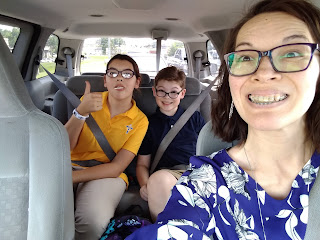

We give school a big thumbs up!

Thursday, May 30, 2019

Last Day of School at Four Maples Academy


Last day of school! It is also our last day of homeschooling at Four Maples Academy. So many emotions today, but mostly thankfulness.

We have absolutely loved the last seven years of educating Gracie and Emmett at home. It gave us the freedom to tailor lessons to each student's needs/speed, and to incorporate therapies and supports to help build a strong educational foundation for each of them. It has been a gift to shepherd the kids through areas of struggle and to celebrate the big and small academic and developmental victories with them. Our morning bible studies have been rich with meaningful conversations and honest questions, which is probably what I will miss the most.

One of my favorite Bible study discussions


It was incredibly humbling and encouraging to recently discover how much Gracie and Emmett have flourished and grown at Four Maples: both kids tested above average in reading comprehension, writing, and math (and Emmett officially skipped a grade somewhere between 1st and 3rd grade). There were definitely tears of joy and relief upon hearing this news. And gratitude. So much gratitude.

The kids will begin a new chapter in the fall... at Christian Academy of Indiana! We're so excited to see how the Lord will lead them to new opportunities in learning, personal growth, and making new friendships. Seventh and fifth grade, here we come!

Thursday, January 12, 2017

Asking for Help


Three math problems. 90 minutes. Equals 30 minutes per problem.

Only four more to go.


A child wrapped in a preteen body, crumpled into a infant's pose. Whimpers. Silent tears dripping down blotchy cheeks.

Alone. Afraid. Angry. And still somehow absent.

Mother, dragging herself through a quagmire of pain, tiredness, and frustration. Reaching for patience and kindness but instead grasping the side of the couch in anger and despair.

Help.

Slowly, Mother lets go and reaches out to touch the shivering shoulder of the child next to her.

Like a spring, the tightly wound girl releases, turns and clings tightly to Mother. Tears fall on her shoulder.

Mother encircles the clinging child and utters words that bubble up from some unseen stream and flow out of her mouth to drip gently down, soaking the wounded and parched hearts below.

It's ok.

I'm proud of you.

You asked for help.

We all need help sometimes.

I am here for you.

I'll always be here for you.

I want to help you.

We can do this.

Let's do it together.


With each word, the trembling slows. Tears subside. The arms still tightly cling as if holding each word close to the chest, afraid to let go.

Ok.

Four math problems. Twenty minutes. Equals smiles and deep sighs of relief.

Thank you.


Friday, December 30, 2016

Declutter with Less Drama - Free Printable

It's nearly the beginning of a new year, and I'm ready to say adieu to 2016 and, "Helloooo 2017!"**
**"And please don't hurt me."

Just as it has been for many others, 2016 has been a year of big ups and downs.  On the upside, school has been going really well this year. We've enjoyed weekly get togethers with other homeschool families to review content, do crafts, and perform science experiments.


Miss Alyssa always makes science fun 

Discussing forms of energy


Another big event that happened this year is that we moved into a new home, which has more room to grow, learn, rest, and show hospitality to family and friends. We now officially have a homeschool room, which is an unexpected blessing. A whole closet dedicated to school supplies?? Be still my heart!

Get schooled. 

Awkward hallway = new school library!

We feel like we've been here for much longer than a few months - the kids' room more than doubled in size and they have loved having so much space to play, draw, create, and build.

Two unfinished doors + IKEA cube shelves =
MEGA DESK

I will confess that I naively thought that more space would automatically translate into less clutter, more room, and more organization. (Look at that photo above when we first moved in! Doesn't it look tidy?)

Nope.

In our case, more space has meant more places for clutter to grow. And grow. And GROW.

I am not a perfect housekeeper. Never will be. It's a losing battle to have an immaculate, stain- and clutter-free home with actual humans in the house. However, our family (especially our kiddo with sensory issues) struggles with too much visual input, at times contributing to a lot of distraction and/or anxiety.  Having visually "quiet" spaces in our home is essential for us to function well.

So today, the kids and I had a family meeting at lunch after seeing them struggle to get their room in order after two days of hard work and effort. The post-Christmas toy surge had totally obliterated any resemblance of order in there, and they had simply run out of places to cram, stow, and stash their loot.  AND they were asking to go to Target to buy even MORE toys with their savings. WHAT?? :/

I will confess that the family meeting came after a less than productive outburst earlier in the morning when the kids went into their room to finish tidying, but they got so overwhelmed and distracted that they promptly forgot their task and started playing Lego instead. I scolded and I dropped the dreaded D-words that my daughter in particular loathes and fears: Declutter. Donate.

So before our meeting, I apologized for my outburst, prayed for wisdom and patience, and did some research. Decluttering can be hard for anyone, but it can be an anxiety-riddled nightmare for some people on the autism spectrum. Lots of change, loss of control, and inability to break down a huge task into smaller steps is just too much to handle without help. We needed a visual aid, and fast.

(scroll to bottom for link to download a free copy)

There were three key issues that we needed to address to ensure decluttering with less drama:

1) Why declutter?

Motivation isn't always obvious. Help your kids understand the benefits of having a clutter free space, and give them a vision for who they might help by giving things away nice but unwanted items to others.


2) What has to go?

Having clear criteria for when it's time to give something away is so helpful. Is it broken? Goodbye. Do I already have a Spiderman action figure? Keep one, donate one. Is it from a fast food kids meal? Sayonara, sucker. They should also have room to store the toys they want to keep - no room on the shelf or under the bed means it's time to thin out the hoard.


3) Clear goals and reward

Set clear expectations and guidelines. The phrase "clean your room" is too vague - do you want all of the books put back on the bookshelf? Or do you only care that the floor is clear of clutter for safe walking? Decide, then communicate goals clearly and precisely. Use pictures for kids who are unable to read or who respond better to visual cues.

Be sure to gauge your expectations on the child's ability and your family's needs (limit to 3-4 goals max - the more goals, the more time/days needed to accomplish them). Since we chose big goals, we only tackled one today and will space out the rest over the next week.

And to ensure proper degree of motivation and enthusiasm, a highly desired reward should be offered when all of the cleaning goals are met. Going out for ice cream is our go-to major reward for very big accomplishments.


So with the Declutter Checklist in hand, G-Bug and Truth ran upstairs to complete the most tear-inducing task on the list first: sorting and downsizing their overpopulated mountain of stuffed animals to a reasonably sized herd. Previous attempts at this have resulted in only parting with one or two fuzzy friends who were mourned over for days (or weeks) with many, many tears.

An hour later, the kids came down with almost HALF of their stuffies packed up and ready to donate. And zero tears. I almost cried with relief.

Half of the hoarde, headed to new homes

So as the new year approaches, you might be planning your own Operation: Simplify. If it would be helpful, feel free to download a FREE copy of our declutter guidelines below. Or make your own! Notebook paper and stick figures are just as effective as Word documents with bullet points. You've got this!


Happy New Year, everyone!

Monday, October 5, 2015

The Blessing of Frequent Breaks (Finding Your Rhythm)

It's Monday morning, 10:36am. We have (almost) hit our mid-point of the school day, and the kids are cheerfully swinging outside and lip syncing to the Frozen movie soundtrack. Life is pretty good.

Let it go! Let it gooooo!

One of my favorite things about homeschooling is the freedom to find your own rhythm and customizing your schedule to fit the needs of your own particular children, and your own needs as well!

Each year at Four Maples has looked a little different. G-bug is in 3rd grade now, and Emmett is in 1st-ish grade (he's somewhere between 1st and 3rd grade, another benefit to homeschool!). Our work loads have increased, and the content overall has become more complex and challenging. We have even added our sweet friend H for preschool twice a week! How do we fit it all in, and meet everyone's educational needs?

Ninja teacher skills.

Just kidding.

Actually, here are three guidelines that have helped Four Maples stay on track (and helped me stay sane!).


#1: A Set Schedule

It usually takes a few weeks, but after some trial and error we usually settle into a routine that overall works great for both myself and the kids. I have been asked by a couple of friends how we conduct our school days, so here is a breakdown of our current daily schedule:

9:00 - 9:25am  - Morning prayer/Bible study (this year: the Book of Matthew)

9:25 - 9:30am  - Break

9:30 - 9:55am  - Handwriting/English (with separate study stations/one-on-one instruction)

9:55 - 10:00am -  Break

10:00 - 10:30am - Geography

10:30 - 11:00am - Snack Break/Free Play (usually outside)

11:00 - 12:00pm - Spelling (one-on-one tutoring style)

12:00 - 12:30pm - Lunch Break/Free Play

12:00 - 1:00pm - Math

1:00 - 1:05pm - Break

1:05 - 1:30pm - Science

1:30 - 1:35pm - Break

1:30 - 2:00pm - Art/Music (not every day - they go to a weekly art class)

Some days look a little different, but this rhythm of learning works best for us. Lots of little breaks with two longer breaks throughout the day has been a HUGE contributor in our kids' willingness and cheerfulness to work hard and enjoy the learning process, and still have time to just play and be kids.


#2: Frequent Breaks

For anyone who has spent time with children, you realize that sitting still isn't one of their fortes. There are developmental reasons for this, as well as individual temperament, personality, physical makeup, and sometimes special needs/considerations. This isn't a bad thing! In fact, children (especially ages 7 and under) need lots of time to move, explore, and play to encourage their natural development and learning, as highlighted in this article.

In short: kids need to be able to move and play. Often.

Breaking up more intensive learning with scheduled times to get up, move, dance, swing, run, or sometimes lay down in bed with a weighted blanket can help reward hard work and motivate through more challenging lessons. We sandwich our hardest subjects between the longer breaks during the day because it will take the most effort to complete and will need time to recover before moving on to the next subject.

Sometimes a kid just needs to ride a bike


Frequent breaks also:

- gives children time to process the information they have learned before jumping into the next subject

- give time to chat together and practice social skills

- allow time for free play and exercise their imaginations (sometimes the history or science lesson beforehand finds its way into the imaginative play, bonus!)

- make it easier to incorporate younger children into lessons (older kids benefit from frequent breaks, but younger kids require them)

- provide opportunities to do therapy games when needed in between subjects to help with focus, attention, sensory needs, etc. For example, G-bug almost always swings during mid-morning snack break, or on cold/rainy days dances/spins downstairs to music. Forward/backward swinging and spinning is calming/regulating for her, which helps to prepare her for the hardest subject of her day (spelling/dictation).

- give the teacher (ahem, ME) time to shift gears, gather supplies, and prepare the next lesson. A five minute play break can also mean a coffee warm up for teacher or to go outside and get some fresh air.


#3 Be Flexible!

Schedules are amazingly helpful in bringing structure and boundaries for kids (which they secretly crave), but they are not ironclad. Schedules are a tool, not the Law.

If a kid is having a really hard day (hello, rainy days - you've come to destroy all of my plans again haven't you?), longer breaks might be necessary. Maybe you need to put off that new meltdown-inducing assignment for a day and instead do some calming therapies or snuggle together and read a chapter book or watch a related video to the subject you're studying. That isn't a failure - that's a win for knowing your kids and recognizing what they need that day.

Audio books from the library are the BEST

And the same principle goes on those rare occasions when a student gets into "the zone" and wants to work ahead on their math/spelling or if he/she wants extra time to dig deeper into their history or science lesson - don't squelch that! Let them! They might be cultivating a passion that will develop into a future calling/career/lifelong interest.

Dynamic Duo created a Lego space shuttle and launch pad while discussing NASA and satellites


Do breaks help your learner? Have you found certain scheduling tricks that have helped you?


Wednesday, July 15, 2015

Speaking in Stories and Autism

A few months ago, my husband Jason ran across a review of Pulitzer Prize-winning reporter Ron Suskind's book Life, Animated: A Story of Sidekicks, Heroes, and Autism. In his book, he describes his son Owen's autism diagnosis and limited communication, and how Owen was able to find his voice by quoting and referencing Disney movies to communicate his feelings and observations of the world around him.

Owen had a breakthrough around six years old, when he observed his brother having a meltdown after a birthday party. He referenced a Disney movie to express his observations of the situation and attempt to understand why his brother was upset.
“ ‘Walter doesn’t want to grow up,’ he [Owen] says evenly, ‘like Mowgli or Peter Pan,’” Mr. Suskind recalls. It is Owen’s first complex sentence, and he says it looking straight at his parents. Later that day, Mr. Suskind picks up a puppet of Iago, the parrot sidekick in Disney’s animated “Aladdin.”
“So, Owen, how ya’ doin’?” he asks in Iago’s voice. “I mean, how does it feel to be you?”
“I’m not happy,” Owen answers. “I don’t have friends. I can’t understand what people say.”
A whole new world begins.*
*Source:  http://www.nytimes.com/2014/05/22/books/life-animated-by-ron-suskind.html?_r=0

His parents immediately saw an opportunity to help Owen learn and communicate using Disney movies as observations of social interaction and understanding emotions. AND IT WORKED.

Owen's story completely resonated with us. Our sweet daughter G-Bug is a social, loving, zany eight-year-old on the autism spectrum. She has come a long way in the three years since her diagnosis, and yet things like expressing her inner thoughts and feelings are still extremely difficult and rarely communicated to anyone.

Like Owen, G-Bug recently displayed just how powerful stories and narratives impact her, and how they can also help her communicate her own thoughts and feelings.

Gracie rediscovered a VHS copy of the movie "The Lion King" in our basement, and asked to watch it over and over. It's a great story - a young lion who tragically loses his father and, assuming he is responsible, runs away. Over time, he realizes that he must face his past, and step into the role he was meant to take: a good and protective leader and king. Gracie was enthralled, but never really wanted to talk about the themes or her thoughts on the movie when I tried to prompt a conversation. I assumed she was just digging the music and the the Pumba fart jokes. What kid wouldn't?

A couple of weeks later, we were sitting at the table doing math problems and singing Hakuna Matata. Out of the blue, she remarked, "You know, the past can hurt sometimes."

Surprised and curious, I said, "Well, yes that's true. Are you thinking of something in particular?"

"Yes," she said. "Like when someone dies."

She then talked about someone she loved like a grandfather who had passed away the year before. She talked about how she saw that his death affected specific people who were still grieving his loss, even though they didn't really show it. I was stunned at her insight, her observations, and her ability to articulate things I had never guessed that she was feeling or observing.

And then the moment passed. Two minutes of deep, heartfelt conversation and then it was abruptly over. She has never talked about those things since.

People are complicated and difficult to understand sometimes. For people with autism, even more so. If you are trying to connect with and love someone on the spectrum, be open to new ways to teach or encourage relationships and empathy toward others. It might require calling on a lion prince, a wise cracking parrot, or a dragon tamer to open a well into a spring of deep thoughts and feelings buried below a seemingly barren surface.


Thursday, April 2, 2015

Having "The Talk" with my daughter

World Autism Awareness Day is coming to a close, and after three years of having the diagnosis I finally had "the talk" with my daughter, telling her she was on the autism spectrum.

I had been sort of dreading the conversation, wondering when it would be best for her to officially know. Mostly because I didn't want her to feel a sense of negativity or over-identification with a particular part of herself that could be seen as limiting or stigmatizing. 

But mostly I was just afraid I'd screw it all up. 

It seemed like such a huge conversation to have with her - so many long term ramifications, possibly even sadness or anger, or confusion. We have talked with her (and her brother in his moments of frustration) about certain issues - how change is harder for her, that she can't tell when someone is getting irritated with her if they don't say so, that sounds, loud and crowded places, and food textures that bother her have to do with how her brain makes them seem louder/painful/sickening to her. But to actually say to her, "You have autism," was not something I was sure she was ready to understand, or something I was ready to say.

So today, the opportunity presented itself over breakfast while I was looking online at some autism awareness pins. G-bug and Truth noticed what I was doing and they asked me what those puzzle pins were on my computer. So we talked about what a diagnosis is, and gave some examples like how we all have allergies and get sneezy in the spring, and that I sleep with a machine at night because of my sleep apnea (you're welcome for that little tidbit of TMI). Because the doctor knows that I stop breathing at night, they can give me a machine that helps me sleep and my body work better.

We talked about how each person is created unique, and with special strengths and weaknesses. And then we talked about autism, that it means that a person's brain might work a little differently than some other people. It makes being flexible and handling change difficult. It might make people's senses go haywire. It might make it hard to understand what other people are thinking and feeling, and how to make friends in some cases. But people on the spectrum can also be really good at things, like photographic memory, or remembering whole narratives or songs without really trying (G-bug was listening intently while I was talking, with no eye contact of course.)

Then we talked about some of our favorite people who are on the autism spectrum, and how some things are hard for them but they are also really good at other things because of their unique brain.

Then I tentatively told Gracie that she is also someone with this condition. I almost cringed anticipating her response.

Without missing a beat, she said matter of factly, "Yeah, I know."

Me: "Really? How did you know?"
G-bug: "You know, because of my legs and how my body feels sometimes."
Me: "And how some things are hard for you?"
G-bug: "Yeah."
Me: "But it's also why you are so good at remembering things you see, and songs you listen to - there's a lot of good and some hard stuff too. God made each of us in His image, special and unique."
G-bug: "Yeah. And can I have two cat vitamins now?"

And that was it.

I don't know what I was expecting, but that certainly wasn't it. She already knew?

As the day progressed, I assumed she had forgotten all about our conversation - nothing was said, and nothing indicated that she gave a second thought to our talk... until later that afternoon while playing Mario Kart at a friend's house. Out of the blue, she asked me to remind our friends that today was World Autism Awareness Day, because she had it, and that it meant that her brain worked differently, and made some things hard for her, but made her really good at other things. And then she promptly went back to her game of Mario Kart.

That's G-bug. Deep conversations like sound bytes in the most surprising moments. And then it's gone.

Now I'm no fool. I know this is the first conversation of many more to come. But the conversation has begun, and instead of dancing around the large puzzle-piece-patterned elephant in the room we are facing it together with honesty and solidarity. I have no idea how being on the autism spectrum will continue to affect her into adolescence, into her teens, into adulthood, into marriage and parenting if that is part of her future. But I know that I'm so glad that I'm her mom, and I'm ready to walk with her through each of those seasons and have as many hard/encouraging/scary/wonderful conversations as she needs to have. And I'm already praying for the ability to do it.

So light it up blue today. For G-bug, for her friends like Jack, and for so many others affected by and living (emphasis on LIVE) with autism.

G-bug snuggles are The. Best.

Saturday, November 8, 2014

Whole Body Listening

Listening to others is hard. If you add additional factors like development, auditory processing challenges, lack of social awareness, sensory issues, attention challenges, etc., it can seem nearly impossible! Sometimes a person/child is actually listening but isn't aware that their body language isn't communicating that to others.

"What? I'm listening! Can't you tell?"


Whatever the reason, a child who struggles with quiet whole body listening can be the recipient of constant correction and scolding, and can result in a very discouraged or frustrated teacher (not that I can relate to that... ahem... cough cough... shuffles away quickly).

Good whole body listening can and should be taught, encouraged, and reinforced in children and adults alike. While expectations of the parent/teacher should be tempered by the child's individual ability (age/development are huge factors in this!), every child can learn to show respect and interest in someone who is talking to him or her, even for short periods of time.

I SEEEE YOU! I HEEEAR YOU!


Our wonderful speech pathologist/social skills therapist provided us with several visual resources to help us with whole body listening:

Listening booklet - This 1/2 page printable booklet clearly explains how we listen to others, including our teachers. It also helps a student learn when they can talk aloud and when we need to listen with our lips closed. The booklet explains what others are thinking when we listen quietly to them (others think you are polite and what they are saying is important to you). You could make more than one copy and keep one in their backpacks, at their desk, at home, put one into their church bag, etc.

Parts of a Listener printable - this adorable poster identifies the different parts of your body that are used when listening: eyes for looking at whoever is talking, a mouth for sharing ideas when it's your turn, hands still so they don't distract others, etc. We have found great success reviewing all of these parts of a listener just before a lesson during school and at church in our special needs Sunday School class. The download is only a dollar, so it's inexpensive too!

Source


Parts of a Friend printable - created by the same teacher, this covers similar information but is more specific to how to be a friend in the way you listen, care, and think about another person. Great for kids who struggle with social awareness.

Fidgets - Your child might also benefit from holding a fidget in their hands/lap while listening to relieve sensory seeking or release need to move and wiggle. (I've also seen kids sit on some fidgets! Whatever works!) As long as it is kept under a desktop out of sight, this can be very helpful for some while avoiding visual distraction to themselves and to others. Click here for some examples and to find something that might work for you.

The important thing to remember is make learning how to listen a positive experience, and to celebrate the small victories - five minutes of sitting quietly and attentively is a huge milestone for some kids, and should be recognized and praised! And consider rewarding excellent whole body listening by following up with a wiggle-friendly activity or free play.

What things help you or your child to listen well?


Wednesday, August 20, 2014

Hard realities, good truth

Here are two hard realities I have learned about teaching/parenting a child with "hidden" special needs:

1) It is very difficult to know where their abilities end and their limitations begin until they have been asked to do something that is beyond their abilities - meltdowns/frustration/despair are usually the indicators of this line.

2) This invisible line can move on a daily/hourly basis, depending on environmental factors, sensory issues, change in schedule, what they ate, how they slept, the change in weather, etc. Something that was a snap one day can be overwhelming the next day, and you may never know why. And neither will they.

A couple of years ago, my dear friend Kathy and I decided that living with autism is a lot like Calvinball - no matter how hard you try to keep up, the rules are constantly changing.


For a while, on really hard days Kathy and I would message each other a one-word message: "Calvinball." The other would immediately know what that meant.


I love teaching my children, and I love that we can homeschool to more easily incorporate sensory diet, gross/fine motor therapies, much needed breaks in between seemingly simple tasks, and to constantly adapt to the rhythms of our children's abilities that day... but it's hard sometimes. Good, hard work. That I wouldn't trade for anything. Work that reminds me almost constantly of my desperate need for God to equip, encourage, and enable me to do this work to the the best of my own very limited abilities.

AND HE DOES. He does. I'm so thankful.

"Now may the God of peace who brought again from the dead our Lord Jesus, the great shepherd of the sheep, by the blood of the eternal covenant, equip you with everything good that you may do his will, working in us that which is pleasing in his sight, through Jesus Christ, to whom be glory forever and ever. Amen." - Hebrews 13:20-21

"Let the word of Christ dwell in you richly, teaching and admonishing one another in all wisdom, singing psalms and hymns and spiritual songs, with thankfulness in your hearts to God. And whatever you do, in word or deed, do everything in the name of the Lord Jesus, giving thanks to God the Father through him." - Colossians 3:16-17

I hope to be as cool as Rosalyn one day.

Wednesday, April 2, 2014

Light It Up Blue!

Today is World Autism Awareness Day, just over the 2 year mark of G-bug's diagnosis on the autism spectrum. She has taught us so much about perseverance, patience, joy, selfless love, grace toward others, and creativity through her daily example.

Some days are incredibly hard, but all days are meaningful and part of her story. She is a gift.


Sunday, September 8, 2013

Guiding Principles for Educating Your Unique Child

Whew, where did the week go? Two therapies in a week makes for little time for anything else, but I have been working on a list of pre-K resources that I hope to have done in the next week (fingers crossed).

But before I do that, I would like to share a few thoughts from well seasoned homeschool veterans that have helped us shape our home education experience - these guidelines have been critical in our selection of homeschool curriculum and how we approach education in our family.  I hope these words encourage and inspire you to love and enjoy learning with your child as much as it has encouraged us!

- Teach to the child, not to the curriculum: Your child was made completely unique.  Because of that, your child (just as every adult) learns and experiences things in his/her own unique way and in his/her own unique pace. You child might love worksheets and checklists, or might prefer games and manipulatives (things to hold/manipulate for better understanding).  Your child might primarily be a visual learner, or an auditory learner, or a kinesthetic (hands on/experiential) learner - and that is a good thing! He/she was created that way for a purpose, and we should work with those given abilities and not against them.

Dr. Kathy Koch, founder of Celebrate Kids, Inc., spoke on this topic at the Midwest Homeschool Convention last year - she identified different giftings as "multiple intelligences." Some of the examples she gives are "word smart," "people smart," "body smart," and "music smart." You can link to her page here.

You might have other considerations to take into account as well.  Your child might struggle with a particular type of learning (children who are extraordinarily gifted in one type of learning tend to struggle in other areas). He/she might have learning challenges, developmental delays, or other factors that might impact their ability to learn certain subjects or skills. Feel freedom to adjust your curriculum and your expectations to best fit your child's needs, and not the other way around. In teaching, primarily focus on your child's abilities as you encourage them in areas of difficulty.

- Any part of life can become a learning experience: Broaden your definition of what learning and education can be.  The main subjects a child typically learns in the early years are reading, math, writing, and life sciences (the world around us). Why do we learn these skills? We learn them because they are the foundation of all other subjects, but also because they are relevant and necessary in our lives! So why not demonstrate that in the way you go through your day with your children?

For younger children, a trip to the grocery store is full of learning possibilities. Play an ABC game and find items that begin with each letter of the alphabet. See/touch/smell different foods and talk about where they come from.  Practice basic math concepts by counting items in your cart or have them find the aisle number you need ("Okay, oatmeal is next on the list! That is in Aisle 7 - who can find Aisle 7 first?"). Do laundry together and let your children sort items by color/texture/size.  Plant and care for a garden together and learn how different fruits/vegetables grow.  Go for a walk in the park and count how many different birds/animals you see and their features.  All of life is an opportunity to learn and engage our children's (and our own) curiosity - and that encourages a love of learning and curiosity that children will take with them long after they have mastered their letters and numbers and have moved on to more advanced subjects. (FYI: This principle applies to older children as well!)

- When possible, let your child's interests guide your lessons/activities.  Does your child love trains? Go to the library to check out books about steam and diesel engines (picture books and research books). Plan a trip to a nearby railway museum. Find a free train themed alphabet worksheet (example: I just searched in Google Images for "alphabet train worksheet preschool" and found this free worksheet - sweet!). Teach them math and counting with train-themed activities (last year, we drew a train track on a piece of paper and used graham crackers to be train cars - we practiced basic addition as we added more cars to our track).


This is actually how we began our tradition of Science Fridays. My kids L-O-V-E science, and the curriculum we had chosen for the year wasn't really meeting their needs or level of interest. So I asked them what they would like to study for science, and they gave me a couple of topics that they were keenly interested in: Ocean life. Space. Bugs. From there, we broke the subjects into 2-3 month unit studies and put together short weekly lessons, mostly drawing from different websites on the internet for related worksheets, activities, and videos (NASA, Discovery network, PBS, and many talented homeschool parents, to name a few).  The kids love it, and it gave me a tangible way to encourage and respect their interests and celebrate how God has uniquely made them.


So whatever you do, make it fun, engaging, and relevant to your child's abilities! It will help you sustain and enjoy this labor of love that is homeschooling, and - more importantly - it will encourage your children to embrace their curiosity and to love learning and explore the world around them.

Sunday, August 18, 2013

Sometimes I forget

As weird as it sounds, sometimes I forget that my oldest, G-Bug, has special needs.  There are some days - if we have had a stable schedule for several days, had a lot of down time at home to decompress, avoided loud/high chaos environments, had good sensory days, the moon has aligned with Venus* - when things seem... well, average. Typical.  On those days, G-Bug and I might have a real, honest to goodness conversation involving real eye contact, relevant questions, and real thoughtful responses. I hear "I love you, Mom" - something (until fairly recently) I rarely ever heard articulated out loud.  Those days I keep close to my heart, sweet and rare gifts from the Lord to refresh and encourage us.

*I am totally kidding about that last one.

But most days are usually full of ups and downs.  Schedules change.  Plans get cancelled.  Loud and chaotic places are inevitable.  Expectations aren't perfectly communicated. We wake up with our sensory input going crazy - lights and sounds hurt, food textures gag us, or we feel so dull that we want to climb, push, rub, chew, scratch, and pick at everything in sight. Brain fog rolls in, clouding our ability to even focus on a one-step task. Change/chaos/fear builds up in our system like a drug, until we hit critical mass and it all comes rushing out, running down our face in our tears and shaking our bodies uncontrollably.

On especially hard days, I forget to be thankful.  I forget to celebrate the small victories, and to remember that each and every completed task is a gift from God Himself.  I forget that there are others whose challenges are more severe, more difficult to manage, and for some there are so few "good days."

And in the darkest moments, I sometimes forget that God is good.

But my daughter's struggles aren't evidence of a God who isn't good or loving - it points to a broken world that needs saving and renewing.  All of our bodies and our experiences carry evidence of a world that is tainted by sickness, evil, and death.  And that is precisely why God sent His Son Jesus - not only to save us from the penalty of our own sin, but to conquer death and give hope of a future reality without illness, abuse, developmental delays, murder, cancer, and on and on.  The hope is real because Jesus is real, His resurrection is real, and God's love and goodness are real and absolute.

And while we wait for that day, God shows His goodness and love to us by walking alongside us in our darkest moments.  Giving us our daily breath, a moment of rest and clarity, a simple "I love you, Momma" from a precious girl's sweet lips.

If your hope is in Jesus, fight not to forget.  The battle is already won, and it was won by a good and loving Father who is going before you, loving you, and sustaining you until the day you will at last see Him face to face, free at last to never to forget again.

Friday, August 16, 2013

Visual Schedules, a.k.a. Sanity Savers


I LOVE visual aids.  We have them all over our house, as our friends and family can attest.  From bathroom duties (potty time, washing hands) to bedtime rules and morning/evening routines, you can literally make a visual schedule for ANYTHING... and we DO.  When any particular task with more than one step becomes a point of frustration for G-Bug or myself ("Go get dressed, please." Five minutes later. "Are you dressed? Where are your socks? Why did you put them THERE??"), I make a visual aid.

A visual aid is simply a list with words and pictures that breaks down any task into smaller steps.  For G-Bug, any simple task can become overwhelming if she's having a hard day.  It is not uncommon for me to ask her to go get dressed, and I will check in on her five minutes later and she is standing in the middle of her room and just looking around. When I remind her what she is supposed to be doing, she startles and apologizes, walks to the dresser, and totally forgets what she is doing again. You can imagine the mutual frustration. AARG.

 If you are quickly losing hair and sleep over helping your child complete routine tasks, please consider trying visual aids.  It doesn't have to be fancy - you can make one on a spare sheet of paper and some crayons (color helps get attention for most kids).  If you want something more formal (or if you fear your drawing skills might cause more confusion than clarity), you can use a program as basic as Microsoft Word or Publisher and some Google images and make a pretty nice chart that you can refer your kids to when they get stuck.

Here are a few that we made to get you started - if you want to tweak these for your own family, feel free to email me to request a copy of the Publisher document and I will be more than happy to share it with you.


We chose to laminate them so G-bug can use a dry erase marker to check off tasks as she completes them (we usually reserve this for days when she is struggling more to see her progress).

Have a great weekend!

UPDATE: I found a great website with a few more visual schedules for basic self-care, like teeth brushing, potty use, washing hands, etc. Click here to access


Monday, January 12, 2009

A Reflection of a Remarkable Woman

(Written on Facebook Jan. 12, 2009)


Many of you know that Lynn McGary, a woman who has been a personal mentor, friend, and like a mother to me has been battling cancer for about seven years now. And many of you know that her condition became very grave last week and she has now been allowed to go home and spend what time she has left with her family and loved ones.

This weekend Jason and I were able to go and be with her and her family who is so much like my own, and to see Lynn, hug her, and tell her how much we love her. I wish I had been able to tell her how much her love and relationship has meant to me for the last few years, but it would have taken much too long and time is so short.

For those of you who don't know Lynn, she is one of the most incredible people I have ever been privileged to know. She, with her husband Ross, founded a soon to be nationwide organization that ministers to families with children with special needs, Stone Soup. Her background in child development and education also provided other opportunities to teach parenting and education seminars locally and internationally, as well as draft a book of baby games for babies from newborn to one year old.

Lynn loves exercising and encouraging creativity in others. She enjoys opening her home to others and hosting people with delicious foods and meaningful conversation. She loves God's many creations with joy and wonder: brilliant colors, beautiful nature scenes, and the intricacy of the human body always elicit comments of amazement and thankfulness.

She is also an amazing wife and mother, daugther and sister - she loves completely without holding back and without giving a second thought to herself. I've heard countless stories she's had with her children, many including her ability to turn potentially difficult situations into "adventures." :) Something her daughter Lisa once told me has always stuck with me: that in all the years she has known her, she never recalls a moment in which Lynn complained about something. Oh, to have that kind of legacy with your grown children.

Lynn doesn't know how to love people half-heartedly - she sees every person as having value and being made in God's image. And she seeks to show them how they really matter, to herself and to her Lord. She greets cashiers at her usual grocery store by name and enquire about their mothers, their children. And she really listens when they answer.

Lynn has played a pivotal role in my own life tenfold, impacting every aspect as an adult, a wife, a mother, and a follower of Christ. She humbles me by her matter-of-factness, her openness and lack of ceremony, and her continual giving of herself to others without expectation of recognition or return. She was first known to me as a mom of a roommate and dear friend who we saw at holidays, but over time I was slowly pulled into the "McGary Force" and soon felt like one of the family.

Ross and Lynn were also an important part of mine and Jason's story of deciding to get married, directly and indirectly. :) They led our premarital counseling and taught us by example what marriage should look like: how to love deeply and with honor and respect, how to face challenges as one no matter what, and how to really laugh together and revel in the joys of marriage. They rejoiced with us at our wedding and delivered the charge to the bride and groom during our ceremony and led a prayer for our future together.


Ross and Lynn were one of the first people we called when we found out that we were expecting a baby, and Lynn helped me cope with the first difficult months of pregnancy and morning sickness. They came up soon after Gracie was born to see her, "their first grand baby," as they call her. Lynn was a listening ear during the dark moments of post pardum and offered much counsel as I floundered and fretted as a new mommy. It was also Lynn who talked me through the fears and questions of an ectopic pregnancy, emergency surgery, and loss shortly after Gracie's first birthday.


Mama Lynn, I wish you could be able to read this and know how much you impacted my own little life - thank you for being such a steady and steadfast presence, always ready with a hug and a kiss and an "I love you, sugar." I look forward one day to see you dance and laugh and sing off key again, free from sickness or grief or weariness... and you will be with the Creator you know and love so well. Thank you for the legacy you leave behind you through your husband, children, brothers, sisters, parents, cousins, students, friends, and on and on and on. We love you and cherish you and all of the memories you leave behind.