Showing posts with label visual aid. Show all posts

Saturday, July 27, 2019

Rise and Shine! Back to School Visual Aid Printables


First day of school! First day of school! Our kids just finished their first (partial) week at their new school and while it's a whole new world of backpacks, lockers, and homework assignments G-bug and Truth are thoroughly enjoying it.

G-bug the 7th grader!

I've also been so blessed with the opportunity to work on campus as a student support aide in the elementary educational resource department, providing assistance for students who need extra support during the school day. It's so wonderful to work in such an amazing school and with such incredible teachers and staff - I'm excited to learn from them this year, and hopefully be a part of creating a positive and exciting learning environment for the students. :)


With this huge shift in our schooling routine, the biggest challenge that we've faced has been getting up early and out the door on time. It has been a new experience for all of us: packing lunches and backpacks, morning car lines, remembering musical instruments, turning in signatures and forms to teachers, and on and on. Thankfully, we were given some counsel from G-bug's neuropsychologist before the school year began to provide laminated visual aids/checklists to use every school night/morning to stay organized. He explained that it would help to minimize anxiety, and would also encourage independence and development of organization skills. It also prevents Mom having to carrying the burden of remembering all the things (especially since Mom's working memory is still recovering after surgery and the years of yuck - I'll post an update on my health soon in a separate post, more good news!)


After three days of school, I can confidently say that these visual aids have been a lifesaver. LIFE. SAVER. Both kids have responded so positively to this system: G-bug is able to practice her executive skills and develop her independence without constant reminders and redirections, and Truth (my super organized but slightly anxious child) finds comfort in knowing exactly what is expected of him.

Lunchbox? Check.
Flute in backpack? Checkity-check.

Every night when it's time for bedtime routine, the kids will start their school night checklists - using a dry erase marker, they check off each box when the task is completed. When they're finished, they have to turn in their checklists to a parent for review (the same goes for the morning checklists). If they miss a step, they are instructed to go back and finish the task. We practiced this routine 1-2 nights/days preceding the start of school to get the hang of it, so that by the first day of school we had worked through any potential issues and could tackle the list with confidence.

In case it is helpful for any parents/students who are preparing for another school year, here are links to customizable versions of these printable checklists  for your family to try - each list is an extra blank checkbox that you can write in any additional tasks particular to your family/child before laminating. (For example, our morning checklists include putting on glasses.) There are two versions to choose from: one that includes medication/vitamins and one that doesn't. 

If there are families who would like a homeschool version, please contact me via email and I'll be happy to create one for you as well!

 School Night/Morning Checklists Printable

 School Night/Morning Checklists NO Meds Printable


Please let me know if you find these helpful! And have a wonderful school year. :)
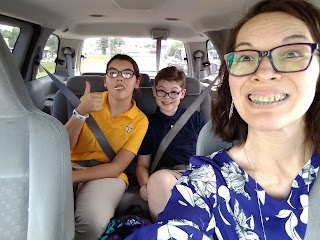

We give school a big thumbs up!

Friday, December 30, 2016

Declutter with Less Drama - Free Printable

It's nearly the beginning of a new year, and I'm ready to say adieu to 2016 and, "Helloooo 2017!"**
**"And please don't hurt me."

Just as it has been for many others, 2016 has been a year of big ups and downs.  On the upside, school has been going really well this year. We've enjoyed weekly get togethers with other homeschool families to review content, do crafts, and perform science experiments.


Miss Alyssa always makes science fun 

Discussing forms of energy


Another big event that happened this year is that we moved into a new home, which has more room to grow, learn, rest, and show hospitality to family and friends. We now officially have a homeschool room, which is an unexpected blessing. A whole closet dedicated to school supplies?? Be still my heart!

Get schooled. 

Awkward hallway = new school library!

We feel like we've been here for much longer than a few months - the kids' room more than doubled in size and they have loved having so much space to play, draw, create, and build.

Two unfinished doors + IKEA cube shelves =
MEGA DESK

I will confess that I naively thought that more space would automatically translate into less clutter, more room, and more organization. (Look at that photo above when we first moved in! Doesn't it look tidy?)

Nope.

In our case, more space has meant more places for clutter to grow. And grow. And GROW.

I am not a perfect housekeeper. Never will be. It's a losing battle to have an immaculate, stain- and clutter-free home with actual humans in the house. However, our family (especially our kiddo with sensory issues) struggles with too much visual input, at times contributing to a lot of distraction and/or anxiety.  Having visually "quiet" spaces in our home is essential for us to function well.

So today, the kids and I had a family meeting at lunch after seeing them struggle to get their room in order after two days of hard work and effort. The post-Christmas toy surge had totally obliterated any resemblance of order in there, and they had simply run out of places to cram, stow, and stash their loot.  AND they were asking to go to Target to buy even MORE toys with their savings. WHAT?? :/

I will confess that the family meeting came after a less than productive outburst earlier in the morning when the kids went into their room to finish tidying, but they got so overwhelmed and distracted that they promptly forgot their task and started playing Lego instead. I scolded and I dropped the dreaded D-words that my daughter in particular loathes and fears: Declutter. Donate.

So before our meeting, I apologized for my outburst, prayed for wisdom and patience, and did some research. Decluttering can be hard for anyone, but it can be an anxiety-riddled nightmare for some people on the autism spectrum. Lots of change, loss of control, and inability to break down a huge task into smaller steps is just too much to handle without help. We needed a visual aid, and fast.

(scroll to bottom for link to download a free copy)

There were three key issues that we needed to address to ensure decluttering with less drama:

1) Why declutter?

Motivation isn't always obvious. Help your kids understand the benefits of having a clutter free space, and give them a vision for who they might help by giving things away nice but unwanted items to others.


2) What has to go?

Having clear criteria for when it's time to give something away is so helpful. Is it broken? Goodbye. Do I already have a Spiderman action figure? Keep one, donate one. Is it from a fast food kids meal? Sayonara, sucker. They should also have room to store the toys they want to keep - no room on the shelf or under the bed means it's time to thin out the hoard.


3) Clear goals and reward

Set clear expectations and guidelines. The phrase "clean your room" is too vague - do you want all of the books put back on the bookshelf? Or do you only care that the floor is clear of clutter for safe walking? Decide, then communicate goals clearly and precisely. Use pictures for kids who are unable to read or who respond better to visual cues.

Be sure to gauge your expectations on the child's ability and your family's needs (limit to 3-4 goals max - the more goals, the more time/days needed to accomplish them). Since we chose big goals, we only tackled one today and will space out the rest over the next week.

And to ensure proper degree of motivation and enthusiasm, a highly desired reward should be offered when all of the cleaning goals are met. Going out for ice cream is our go-to major reward for very big accomplishments.


So with the Declutter Checklist in hand, G-Bug and Truth ran upstairs to complete the most tear-inducing task on the list first: sorting and downsizing their overpopulated mountain of stuffed animals to a reasonably sized herd. Previous attempts at this have resulted in only parting with one or two fuzzy friends who were mourned over for days (or weeks) with many, many tears.

An hour later, the kids came down with almost HALF of their stuffies packed up and ready to donate. And zero tears. I almost cried with relief.

Half of the hoarde, headed to new homes

So as the new year approaches, you might be planning your own Operation: Simplify. If it would be helpful, feel free to download a FREE copy of our declutter guidelines below. Or make your own! Notebook paper and stick figures are just as effective as Word documents with bullet points. You've got this!


Happy New Year, everyone!

Saturday, November 8, 2014

Whole Body Listening

Listening to others is hard. If you add additional factors like development, auditory processing challenges, lack of social awareness, sensory issues, attention challenges, etc., it can seem nearly impossible! Sometimes a person/child is actually listening but isn't aware that their body language isn't communicating that to others.

"What? I'm listening! Can't you tell?"


Whatever the reason, a child who struggles with quiet whole body listening can be the recipient of constant correction and scolding, and can result in a very discouraged or frustrated teacher (not that I can relate to that... ahem... cough cough... shuffles away quickly).

Good whole body listening can and should be taught, encouraged, and reinforced in children and adults alike. While expectations of the parent/teacher should be tempered by the child's individual ability (age/development are huge factors in this!), every child can learn to show respect and interest in someone who is talking to him or her, even for short periods of time.

I SEEEE YOU! I HEEEAR YOU!


Our wonderful speech pathologist/social skills therapist provided us with several visual resources to help us with whole body listening:

Listening booklet - This 1/2 page printable booklet clearly explains how we listen to others, including our teachers. It also helps a student learn when they can talk aloud and when we need to listen with our lips closed. The booklet explains what others are thinking when we listen quietly to them (others think you are polite and what they are saying is important to you). You could make more than one copy and keep one in their backpacks, at their desk, at home, put one into their church bag, etc.

Parts of a Listener printable - this adorable poster identifies the different parts of your body that are used when listening: eyes for looking at whoever is talking, a mouth for sharing ideas when it's your turn, hands still so they don't distract others, etc. We have found great success reviewing all of these parts of a listener just before a lesson during school and at church in our special needs Sunday School class. The download is only a dollar, so it's inexpensive too!

Source


Parts of a Friend printable - created by the same teacher, this covers similar information but is more specific to how to be a friend in the way you listen, care, and think about another person. Great for kids who struggle with social awareness.

Fidgets - Your child might also benefit from holding a fidget in their hands/lap while listening to relieve sensory seeking or release need to move and wiggle. (I've also seen kids sit on some fidgets! Whatever works!) As long as it is kept under a desktop out of sight, this can be very helpful for some while avoiding visual distraction to themselves and to others. Click here for some examples and to find something that might work for you.

The important thing to remember is make learning how to listen a positive experience, and to celebrate the small victories - five minutes of sitting quietly and attentively is a huge milestone for some kids, and should be recognized and praised! And consider rewarding excellent whole body listening by following up with a wiggle-friendly activity or free play.

What things help you or your child to listen well?