
Showing posts with label parenting. Show all posts

Saturday, July 27, 2019

Rise and Shine! Back to School Visual Aid Printables


First day of school! First day of school! Our kids just finished their first (partial) week at their new school and while it's a whole new world of backpacks, lockers, and homework assignments G-bug and Truth are thoroughly enjoying it.

G-bug the 7th grader!

I've also been so blessed with the opportunity to work on campus as a student support aide in the elementary educational resource department, providing assistance for students who need extra support during the school day. It's so wonderful to work in such an amazing school and with such incredible teachers and staff - I'm excited to learn from them this year, and hopefully be a part of creating a positive and exciting learning environment for the students. :)


With this huge shift in our schooling routine, the biggest challenge that we've faced has been getting up early and out the door on time. It has been a new experience for all of us: packing lunches and backpacks, morning car lines, remembering musical instruments, turning in signatures and forms to teachers, and on and on. Thankfully, we were given some counsel from G-bug's neuropsychologist before the school year began to provide laminated visual aids/checklists to use every school night/morning to stay organized. He explained that it would help to minimize anxiety, and would also encourage independence and development of organization skills. It also prevents Mom having to carrying the burden of remembering all the things (especially since Mom's working memory is still recovering after surgery and the years of yuck - I'll post an update on my health soon in a separate post, more good news!)


After three days of school, I can confidently say that these visual aids have been a lifesaver. LIFE. SAVER. Both kids have responded so positively to this system: G-bug is able to practice her executive skills and develop her independence without constant reminders and redirections, and Truth (my super organized but slightly anxious child) finds comfort in knowing exactly what is expected of him.

Lunchbox? Check.
Flute in backpack? Checkity-check.

Every night when it's time for bedtime routine, the kids will start their school night checklists - using a dry erase marker, they check off each box when the task is completed. When they're finished, they have to turn in their checklists to a parent for review (the same goes for the morning checklists). If they miss a step, they are instructed to go back and finish the task. We practiced this routine 1-2 nights/days preceding the start of school to get the hang of it, so that by the first day of school we had worked through any potential issues and could tackle the list with confidence.

In case it is helpful for any parents/students who are preparing for another school year, here are links to customizable versions of these printable checklists  for your family to try - each list is an extra blank checkbox that you can write in any additional tasks particular to your family/child before laminating. (For example, our morning checklists include putting on glasses.) There are two versions to choose from: one that includes medication/vitamins and one that doesn't. 

If there are families who would like a homeschool version, please contact me via email and I'll be happy to create one for you as well!

 School Night/Morning Checklists Printable

 School Night/Morning Checklists NO Meds Printable


Please let me know if you find these helpful! And have a wonderful school year. :)
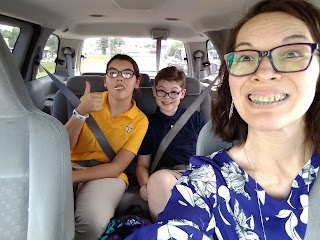

We give school a big thumbs up!

Sunday, January 13, 2019

Goodbye, 2018.

2018, I'm glad to see the back of you.

We survived a crazy year, folks. I shared most of the weightiest Gains and Losses of 2018 in a previous blog, and the ripples from those changes have continued to reshape many aspects of our lives. It has been a rather intense season of rebuilding and adapting to the new normal with all of its ups and downs, to say the least.

But we've been thankful for so many beautiful moments this year as well, and they are worth mentioning here.


For G-bug's 11th birthday, she asked to do two of Papaw's favorite things to celebrate: have a family fishing day and eat at Golden Corral. I can't think of a better way to remember Dad and to celebrate life. He would have been so touched to know how much G-bug wanted to honor him on her birthday. That girl never ceases to amaze me.


"I got another one!"


We took Dad with us. It seemed right to have him there.


This fall, we finally got around to getting family photos for the first time in 5+ years. (Thanks, Kristen Williams for the amazing photos!)  It's crazy how much the kids have grown up and what amazing human beings they are and are still becoming.

Hand in hand, heart to heart

The whole gang!💗


We also welcomed a new nephew into the world, and his sweet adorableness is off the charts.

Baby Jack Jack. 
His cuteness knows no bounds.


My younger brother also graduated with his masters degree in computer science this December, and I couldn't be prouder. Congrats, Ken!

Mom, sister in law, and the graduate 💓

This was also a year of all of the firsts without Dad: first birthdays, first Thanksgiving (he taught me how to cook a turkey as a teenager, and we prepared Thanksgiving together most years through college). This was the first Christmas without him. He loved Christmas.

My brother and I did go visit Dad's place at the Kentucky Veteran Cemetery in Fort Knox, and were so touched to see all of the beautiful wreaths laid on every grave for Christmas. It was such a beautiful tribute to all of the veterans who were there, and a tremendous gift of love for the families who were missing them during the holidays.

Merry Christmas, Dad

Joy and sorrow, tears and laughter. A tapestry of trials and triumphs, woven together into an intricate display of life in all of its shades, shadows, and textures. There was enough sorrow and tears to drown us this year, but enough moments of beauty and joy to sustain us as well. Those moments were not by chance, but tangible gifts of grace from a loving God.

"When the perishable has been clothed with the imperishable and the mortal with immortality, then the saying that is written will come to pass: 'Death has been swallowed up in victory.'

'Where, O death, is your victory? Where, O death, is your sting?'

The sting of death is sin, and the power of sin is the Law. But thanks be to God, who gives us the victory through our Lord Jesus Christ! Therefore, my beloved brothers, be steadfast and immovable. Always excel in the work of the Lord, because you know that your labor in the Lord is not in vain."

- 1 Corinthians 15:54-58

Death is not the final word. Christ will one day triumph over death once and for all. And in that we can remain steadfast, sturdy in the hope He provides.

Thursday, January 12, 2017

Asking for Help


Three math problems. 90 minutes. Equals 30 minutes per problem.

Only four more to go.


A child wrapped in a preteen body, crumpled into a infant's pose. Whimpers. Silent tears dripping down blotchy cheeks.

Alone. Afraid. Angry. And still somehow absent.

Mother, dragging herself through a quagmire of pain, tiredness, and frustration. Reaching for patience and kindness but instead grasping the side of the couch in anger and despair.

Help.

Slowly, Mother lets go and reaches out to touch the shivering shoulder of the child next to her.

Like a spring, the tightly wound girl releases, turns and clings tightly to Mother. Tears fall on her shoulder.

Mother encircles the clinging child and utters words that bubble up from some unseen stream and flow out of her mouth to drip gently down, soaking the wounded and parched hearts below.

It's ok.

I'm proud of you.

You asked for help.

We all need help sometimes.

I am here for you.

I'll always be here for you.

I want to help you.

We can do this.

Let's do it together.


With each word, the trembling slows. Tears subside. The arms still tightly cling as if holding each word close to the chest, afraid to let go.

Ok.

Four math problems. Twenty minutes. Equals smiles and deep sighs of relief.

Thank you.


Friday, December 30, 2016

Declutter with Less Drama - Free Printable

It's nearly the beginning of a new year, and I'm ready to say adieu to 2016 and, "Helloooo 2017!"**
**"And please don't hurt me."

Just as it has been for many others, 2016 has been a year of big ups and downs.  On the upside, school has been going really well this year. We've enjoyed weekly get togethers with other homeschool families to review content, do crafts, and perform science experiments.


Miss Alyssa always makes science fun 

Discussing forms of energy


Another big event that happened this year is that we moved into a new home, which has more room to grow, learn, rest, and show hospitality to family and friends. We now officially have a homeschool room, which is an unexpected blessing. A whole closet dedicated to school supplies?? Be still my heart!

Get schooled. 

Awkward hallway = new school library!

We feel like we've been here for much longer than a few months - the kids' room more than doubled in size and they have loved having so much space to play, draw, create, and build.

Two unfinished doors + IKEA cube shelves =
MEGA DESK

I will confess that I naively thought that more space would automatically translate into less clutter, more room, and more organization. (Look at that photo above when we first moved in! Doesn't it look tidy?)

Nope.

In our case, more space has meant more places for clutter to grow. And grow. And GROW.

I am not a perfect housekeeper. Never will be. It's a losing battle to have an immaculate, stain- and clutter-free home with actual humans in the house. However, our family (especially our kiddo with sensory issues) struggles with too much visual input, at times contributing to a lot of distraction and/or anxiety.  Having visually "quiet" spaces in our home is essential for us to function well.

So today, the kids and I had a family meeting at lunch after seeing them struggle to get their room in order after two days of hard work and effort. The post-Christmas toy surge had totally obliterated any resemblance of order in there, and they had simply run out of places to cram, stow, and stash their loot.  AND they were asking to go to Target to buy even MORE toys with their savings. WHAT?? :/

I will confess that the family meeting came after a less than productive outburst earlier in the morning when the kids went into their room to finish tidying, but they got so overwhelmed and distracted that they promptly forgot their task and started playing Lego instead. I scolded and I dropped the dreaded D-words that my daughter in particular loathes and fears: Declutter. Donate.

So before our meeting, I apologized for my outburst, prayed for wisdom and patience, and did some research. Decluttering can be hard for anyone, but it can be an anxiety-riddled nightmare for some people on the autism spectrum. Lots of change, loss of control, and inability to break down a huge task into smaller steps is just too much to handle without help. We needed a visual aid, and fast.

(scroll to bottom for link to download a free copy)

There were three key issues that we needed to address to ensure decluttering with less drama:

1) Why declutter?

Motivation isn't always obvious. Help your kids understand the benefits of having a clutter free space, and give them a vision for who they might help by giving things away nice but unwanted items to others.


2) What has to go?

Having clear criteria for when it's time to give something away is so helpful. Is it broken? Goodbye. Do I already have a Spiderman action figure? Keep one, donate one. Is it from a fast food kids meal? Sayonara, sucker. They should also have room to store the toys they want to keep - no room on the shelf or under the bed means it's time to thin out the hoard.


3) Clear goals and reward

Set clear expectations and guidelines. The phrase "clean your room" is too vague - do you want all of the books put back on the bookshelf? Or do you only care that the floor is clear of clutter for safe walking? Decide, then communicate goals clearly and precisely. Use pictures for kids who are unable to read or who respond better to visual cues.

Be sure to gauge your expectations on the child's ability and your family's needs (limit to 3-4 goals max - the more goals, the more time/days needed to accomplish them). Since we chose big goals, we only tackled one today and will space out the rest over the next week.

And to ensure proper degree of motivation and enthusiasm, a highly desired reward should be offered when all of the cleaning goals are met. Going out for ice cream is our go-to major reward for very big accomplishments.


So with the Declutter Checklist in hand, G-Bug and Truth ran upstairs to complete the most tear-inducing task on the list first: sorting and downsizing their overpopulated mountain of stuffed animals to a reasonably sized herd. Previous attempts at this have resulted in only parting with one or two fuzzy friends who were mourned over for days (or weeks) with many, many tears.

An hour later, the kids came down with almost HALF of their stuffies packed up and ready to donate. And zero tears. I almost cried with relief.

Half of the hoarde, headed to new homes

So as the new year approaches, you might be planning your own Operation: Simplify. If it would be helpful, feel free to download a FREE copy of our declutter guidelines below. Or make your own! Notebook paper and stick figures are just as effective as Word documents with bullet points. You've got this!


Happy New Year, everyone!

Saturday, October 15, 2016

Create Fearlessly

(This was a story I shared with the Hutchmoot Facebook group "The Rabbit Room Chinwag" earlier this week. I am sharing it here to remind myself of these wondeful truths when I so often give into the fear that can crush joyful creativity.)

After asking a million questions about our weekend at Hutchmoot** this past weekend, our 7 year old Truth decided last night to become an author and eagerly began writing his first novel about a mad scientist. He carefully jotted down some general notes, drew a book cover, and even penned a "note to the reader."


When he woke up the next morning, he grabbed his notes and started scribbling down the first chapter with gusto. Ten minutes later, I noticed that he was sitting very still. Then he turned to me with tears in his eyes and asked in a very small voice, "Mom, what if nobody likes it?"

Joy of creativity was shadowed by fear. We've all been there. It was an extremely sensitive moment, and I froze.

By God's grace, I was reminded of so many wonderful truths that were gleaned from the weekend that I could share with him. Randall Goodgame and Katy Bowser's talk about children and the importance of encouraging them in creativity without shame. Sally Clarkson's exhortation to remind our children that they have an important part in God's megastory to fulfill. Clay Clarkson creating a safe space for terrified musicians to share a piece of their story through song without fear of reproach. Diana Glyer's talk about the Inklings, the importance of encouragement in creative community, and even the horrific fact that the Narnia series was almost trashed before it was even fully written because of a critical word. (Truth's eyes were huge when I told him this and he was furious with Tolkien for the next hour.)

By divine providence and provision, we could address his fears and encourage him to press on. He's now working on chapter 2 and asking how to spell "transport-inator."


Thank you to the creators/leaders/volunteers/speakers/fellow participants of the Rabbit Room - for equipping us to raise up the next generation to create fearlessly. All of your work in not in vain.


**Defining Hutchmoot is like trying to explain an indefinable something, too broad and rich to fit into a narrow category. In simple terms, it's a gathering of Christians who love expressing and/or celebrating creativity, primarily through writing, music, visual arts, animation/film, etc. (Though there were many other people who express creativity in other ways - see what I mean? Indefinable something!)  Jason and I were able to go together for our 10 year anniversary getaway, and it was refreshing and inspiring.

Monday, October 5, 2015

The Blessing of Frequent Breaks (Finding Your Rhythm)

It's Monday morning, 10:36am. We have (almost) hit our mid-point of the school day, and the kids are cheerfully swinging outside and lip syncing to the Frozen movie soundtrack. Life is pretty good.

Let it go! Let it gooooo!

One of my favorite things about homeschooling is the freedom to find your own rhythm and customizing your schedule to fit the needs of your own particular children, and your own needs as well!

Each year at Four Maples has looked a little different. G-bug is in 3rd grade now, and Emmett is in 1st-ish grade (he's somewhere between 1st and 3rd grade, another benefit to homeschool!). Our work loads have increased, and the content overall has become more complex and challenging. We have even added our sweet friend H for preschool twice a week! How do we fit it all in, and meet everyone's educational needs?

Ninja teacher skills.

Just kidding.

Actually, here are three guidelines that have helped Four Maples stay on track (and helped me stay sane!).


#1: A Set Schedule

It usually takes a few weeks, but after some trial and error we usually settle into a routine that overall works great for both myself and the kids. I have been asked by a couple of friends how we conduct our school days, so here is a breakdown of our current daily schedule:

9:00 - 9:25am  - Morning prayer/Bible study (this year: the Book of Matthew)

9:25 - 9:30am  - Break

9:30 - 9:55am  - Handwriting/English (with separate study stations/one-on-one instruction)

9:55 - 10:00am -  Break

10:00 - 10:30am - Geography

10:30 - 11:00am - Snack Break/Free Play (usually outside)

11:00 - 12:00pm - Spelling (one-on-one tutoring style)

12:00 - 12:30pm - Lunch Break/Free Play

12:00 - 1:00pm - Math

1:00 - 1:05pm - Break

1:05 - 1:30pm - Science

1:30 - 1:35pm - Break

1:30 - 2:00pm - Art/Music (not every day - they go to a weekly art class)

Some days look a little different, but this rhythm of learning works best for us. Lots of little breaks with two longer breaks throughout the day has been a HUGE contributor in our kids' willingness and cheerfulness to work hard and enjoy the learning process, and still have time to just play and be kids.


#2: Frequent Breaks

For anyone who has spent time with children, you realize that sitting still isn't one of their fortes. There are developmental reasons for this, as well as individual temperament, personality, physical makeup, and sometimes special needs/considerations. This isn't a bad thing! In fact, children (especially ages 7 and under) need lots of time to move, explore, and play to encourage their natural development and learning, as highlighted in this article.

In short: kids need to be able to move and play. Often.

Breaking up more intensive learning with scheduled times to get up, move, dance, swing, run, or sometimes lay down in bed with a weighted blanket can help reward hard work and motivate through more challenging lessons. We sandwich our hardest subjects between the longer breaks during the day because it will take the most effort to complete and will need time to recover before moving on to the next subject.

Sometimes a kid just needs to ride a bike


Frequent breaks also:

- gives children time to process the information they have learned before jumping into the next subject

- give time to chat together and practice social skills

- allow time for free play and exercise their imaginations (sometimes the history or science lesson beforehand finds its way into the imaginative play, bonus!)

- make it easier to incorporate younger children into lessons (older kids benefit from frequent breaks, but younger kids require them)

- provide opportunities to do therapy games when needed in between subjects to help with focus, attention, sensory needs, etc. For example, G-bug almost always swings during mid-morning snack break, or on cold/rainy days dances/spins downstairs to music. Forward/backward swinging and spinning is calming/regulating for her, which helps to prepare her for the hardest subject of her day (spelling/dictation).

- give the teacher (ahem, ME) time to shift gears, gather supplies, and prepare the next lesson. A five minute play break can also mean a coffee warm up for teacher or to go outside and get some fresh air.


#3 Be Flexible!

Schedules are amazingly helpful in bringing structure and boundaries for kids (which they secretly crave), but they are not ironclad. Schedules are a tool, not the Law.

If a kid is having a really hard day (hello, rainy days - you've come to destroy all of my plans again haven't you?), longer breaks might be necessary. Maybe you need to put off that new meltdown-inducing assignment for a day and instead do some calming therapies or snuggle together and read a chapter book or watch a related video to the subject you're studying. That isn't a failure - that's a win for knowing your kids and recognizing what they need that day.

Audio books from the library are the BEST

And the same principle goes on those rare occasions when a student gets into "the zone" and wants to work ahead on their math/spelling or if he/she wants extra time to dig deeper into their history or science lesson - don't squelch that! Let them! They might be cultivating a passion that will develop into a future calling/career/lifelong interest.

Dynamic Duo created a Lego space shuttle and launch pad while discussing NASA and satellites


Do breaks help your learner? Have you found certain scheduling tricks that have helped you?


Wednesday, April 2, 2014

Light It Up Blue!

Today is World Autism Awareness Day, just over the 2 year mark of G-bug's diagnosis on the autism spectrum. She has taught us so much about perseverance, patience, joy, selfless love, grace toward others, and creativity through her daily example.

Some days are incredibly hard, but all days are meaningful and part of her story. She is a gift.


Sunday, September 8, 2013

Guiding Principles for Educating Your Unique Child

Whew, where did the week go? Two therapies in a week makes for little time for anything else, but I have been working on a list of pre-K resources that I hope to have done in the next week (fingers crossed).

But before I do that, I would like to share a few thoughts from well seasoned homeschool veterans that have helped us shape our home education experience - these guidelines have been critical in our selection of homeschool curriculum and how we approach education in our family.  I hope these words encourage and inspire you to love and enjoy learning with your child as much as it has encouraged us!

- Teach to the child, not to the curriculum: Your child was made completely unique.  Because of that, your child (just as every adult) learns and experiences things in his/her own unique way and in his/her own unique pace. You child might love worksheets and checklists, or might prefer games and manipulatives (things to hold/manipulate for better understanding).  Your child might primarily be a visual learner, or an auditory learner, or a kinesthetic (hands on/experiential) learner - and that is a good thing! He/she was created that way for a purpose, and we should work with those given abilities and not against them.

Dr. Kathy Koch, founder of Celebrate Kids, Inc., spoke on this topic at the Midwest Homeschool Convention last year - she identified different giftings as "multiple intelligences." Some of the examples she gives are "word smart," "people smart," "body smart," and "music smart." You can link to her page here.

You might have other considerations to take into account as well.  Your child might struggle with a particular type of learning (children who are extraordinarily gifted in one type of learning tend to struggle in other areas). He/she might have learning challenges, developmental delays, or other factors that might impact their ability to learn certain subjects or skills. Feel freedom to adjust your curriculum and your expectations to best fit your child's needs, and not the other way around. In teaching, primarily focus on your child's abilities as you encourage them in areas of difficulty.

- Any part of life can become a learning experience: Broaden your definition of what learning and education can be.  The main subjects a child typically learns in the early years are reading, math, writing, and life sciences (the world around us). Why do we learn these skills? We learn them because they are the foundation of all other subjects, but also because they are relevant and necessary in our lives! So why not demonstrate that in the way you go through your day with your children?

For younger children, a trip to the grocery store is full of learning possibilities. Play an ABC game and find items that begin with each letter of the alphabet. See/touch/smell different foods and talk about where they come from.  Practice basic math concepts by counting items in your cart or have them find the aisle number you need ("Okay, oatmeal is next on the list! That is in Aisle 7 - who can find Aisle 7 first?"). Do laundry together and let your children sort items by color/texture/size.  Plant and care for a garden together and learn how different fruits/vegetables grow.  Go for a walk in the park and count how many different birds/animals you see and their features.  All of life is an opportunity to learn and engage our children's (and our own) curiosity - and that encourages a love of learning and curiosity that children will take with them long after they have mastered their letters and numbers and have moved on to more advanced subjects. (FYI: This principle applies to older children as well!)

- When possible, let your child's interests guide your lessons/activities.  Does your child love trains? Go to the library to check out books about steam and diesel engines (picture books and research books). Plan a trip to a nearby railway museum. Find a free train themed alphabet worksheet (example: I just searched in Google Images for "alphabet train worksheet preschool" and found this free worksheet - sweet!). Teach them math and counting with train-themed activities (last year, we drew a train track on a piece of paper and used graham crackers to be train cars - we practiced basic addition as we added more cars to our track).


This is actually how we began our tradition of Science Fridays. My kids L-O-V-E science, and the curriculum we had chosen for the year wasn't really meeting their needs or level of interest. So I asked them what they would like to study for science, and they gave me a couple of topics that they were keenly interested in: Ocean life. Space. Bugs. From there, we broke the subjects into 2-3 month unit studies and put together short weekly lessons, mostly drawing from different websites on the internet for related worksheets, activities, and videos (NASA, Discovery network, PBS, and many talented homeschool parents, to name a few).  The kids love it, and it gave me a tangible way to encourage and respect their interests and celebrate how God has uniquely made them.


So whatever you do, make it fun, engaging, and relevant to your child's abilities! It will help you sustain and enjoy this labor of love that is homeschooling, and - more importantly - it will encourage your children to embrace their curiosity and to love learning and explore the world around them.

Monday, August 26, 2013

Boredom Busters

"Moooom! I'm BOOOOOORED!"

Dreaded words... usually because it tends to devolve into a chorus of whining, chanting voices: ("MOOOOOOOMMMM..... Mom? Mom? Mom? Mom? Mommy? Mom?")


There are several approaches to addressing boredom:

1) Put them to work: "Great! Because I have some chores that need to be done.  Grab a broom please."

2) Redirect to other activities: "Okay, see how big of a tower you can make using only books and blocks! When you are done we can measure how tall it is."

3) Incorporate them into whatever you are doing, when possible: "Well, I'm working on a grocery list - can you be on fridge duty and help me check if we still have these items or if we need to get more?"

4) Help them solve their boredom by encouraging them to come up with a solution themselves: "Okay, you are bored. What are you going to do about it?"

Generally, we go with #4 first - we want to encourage them to realize that being bored isn't a passive state of being, but a choice.  You can choose to be bored, or choose to do something.  Some days it's enough to simply ask them, "What are you going to do about it?" and watch them take ownership of the problem themselves and find a solution on their own. 

But other days they JUST can't THINK of ANYTHING to DO... what to do?

Enter a helpful tool: the Boredom Buster Box.


TA-DAA!


We store the box within easy reach, but keep the contents concealed to maintain some degree of novelty when boredom strikes.


Inside, the Box is loaded with all sorts of fun stuff:
- Games/cards that can be played with 1-2 people
- Dry erase crayons/markers with white boards and dry erase workbooks
- Pattern blocks
- Lite-Brite (can you believe they still make those?)
- Silly Putty
- A sticker album and a page of stickers to add to the collection
- Crayons, markers, and paper
- Flash cards with interesting pictures of planets/animals to flip through
- Whatever can be safely played with or investigated on one's own with minimal supervision.

I should also call this the "I just need that extra 15-30 minutes to finish a task that can't be put off" box.

But that wouldn't fit on a label.

Also inside: a small container labeled "Boredom Buster Challenges"


Inside are slips of paper with fun "challenges" for kids to try - here are a few examples:
- Make a tent with a sheet in the living room
- Dress up as pirates and go outside to hunt for "treasure." Watch out for sea monsters!
- Have a tea party, invite your 3 favorite stuffed animals
- Find 5 leaves outside and make a crayon rubbing
- Find your favorite book and act it out with puppets
- Build a race track for your cars using books and blocks
- Draw a picture for a grandparent to send in the mail
- Set up a toy store - sort toys by size/color/shape
- Build a sandcastle

Note: All Boredom Buster Challenges are made way more fun with an adult participant joining in. :)


What do you do to battle boredom?